
How LED Fishing Lights Attract Fish: The Science Behind Squid Fishing & Special Wavelength Technology
11/19/20256 min read
In modern commercial fishing—especially squid fishing—LED fishing lights have become one of the most essential tools on every fishing vessel. Compared to traditional metal-halide lamps, LED technology not only provides stronger and more stable brightness but also uses specific wavelengths to attract fish more efficiently.
But how do fishing lights actually work?
Why do fish swim toward certain colors of light?
And why are StarHSY fishing lights designed with special wavelengths instead of ordinary LEDs?
This article breaks down the science behind LED fishing lights and explains how fishermen can maximize catch rate while lowering fuel consumption.
1. Why Fish Are Naturally Attracted to Light
Fish have a biological instinct known as phototaxis—a behavior that makes them move toward or away from light. Many species, especially squid, sardines, anchovies, and mackerel, exhibit strong positive phototaxis.
There are three main reasons:
1) Light Attracts Plankton
Small organisms gather near the light source at night.
Small fish come to feed on plankton.
Bigger fish come to feed on small fish.
This creates a food-chain aggregation effect.
2) Light Helps Fish Orient Themselves
In dark environments, light becomes a navigation point. Fish subconsciously swim toward stable light sources, forming dense clusters.
3) Certain Wavelengths Trigger Stronger Responses
Fish do not respond equally to all types of light.
Research shows that blue-green wavelengths (around 450–520 nm) penetrate water the deepest and trigger the strongest biological attraction.
This is why professional squid boats use specific colors such as:
🔵 Cyan
🟢 Green
⚪ White
Rather than random RGB colors.
2. LED vs Metal-Halide: Why LED Is the New Standard for Squid Fishing
Fishing fleets worldwide are rapidly moving away from metal-halide lamps and upgrading to high-efficiency LED fishing lights.
Here’s why:
✔ LED Lights Turn On Instantly — No 20-Minute Warm-Up Like Metal-Halide
When fishermen work at night, every minute matters.
Traditional metal-halide lamps require a 15–20 minute warm-up period before they reach full brightness. During this time, the light is weak, unstable, and attracts very few fish.
LED fishing lights solve this problem completely.
✔ Higher Fish-Attracting Efficiency
LEDs produce more usable light per watt and maintain consistent brightness without dimming or color decay.
✔ Longer Lifespan
StarHSY 1000W LED Fishing light designed for 50,000 hours lifespan, reducing replacement costs during long voyages.
✔ Safer & Cooler
LED fishing lights produce minimal heat, reducing risk of burns, explosion, or water-damage compared to metal-halide bulbs.
✔ Special Wavelength Precision
Modern LED fishing lights—especially professional models like StarHSY—use engineered wavelengths that match the visual sensitivity of target fish species.
3. The Importance of Special Wavelength LED Fishing Lights
Not all LED fishing lights are created equal.
Consumer-grade LEDs are designed for indoor lighting, not for marine biological attraction.
To effectively attract fish, a fishing light must use wavelengths tuned to the visual receptors of fish such as:
🐟 Sardines
🐟 Anchovies
🦑 Squid
🐟 Mackerel
🐟 Yellowtail
Why StarHSY Uses Special Wavelength Technology
StarHSY fishing lights use LEDs calibrated at specific nanometer ranges proven to attract fish more effectively:
Modern LED fishing lights differ significantly in performance depending on their spectral output. Professional offshore fishing—especially squid fishing—relies on light sources that match the visual sensitivity of marine organisms. For this reason, wavelength-engineered LEDs are now preferred over general-purpose lighting products.
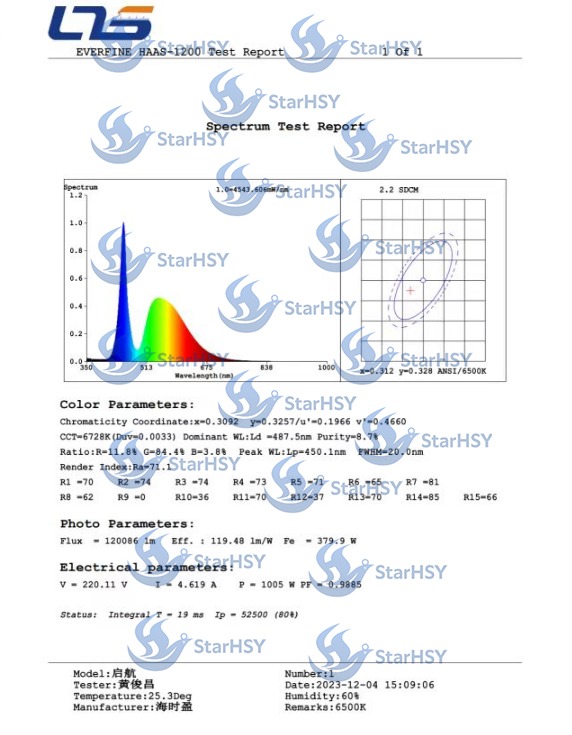
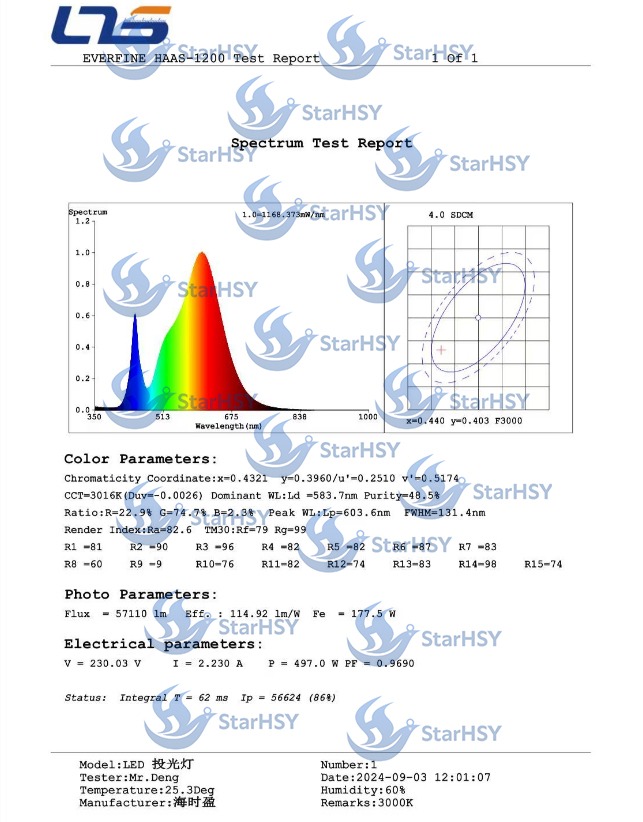
Independent spectrum analysis of StarHSY LED fishing lights shows two critical wavelength features:
① Cyan LED — Dominant peak at approximately 487–490 nm
The cyan spectrum exhibits a narrow, high-purity peak centered at ~487–490 nm, precisely positioned within the blue-green range known for its exceptional water penetration. This wavelength range aligns closely with the sensitivity curve of squid, baitfish (such as sardines and anchovies), and planktonic species.
Key advantages of this wavelength band include:
Deep underwater transmission
Blue-green wavelengths penetrate seawater more effectively than warm colors, enabling a larger attraction radius.High biological responsiveness
Numerous marine species exhibit positive phototaxis toward the 470–500 nm band, making this wavelength highly efficient for aggregation.Stronger food-chain attraction
Plankton gather first, followed by baitfish, and ultimately squid, creating a multi-level clustering effect.
The cyan test report indicates high spectral purity and a sharp emission peak, characteristics that enhance underwater visibility and biological attraction.
② White LED — Broad-spectrum illumination with a peak around 583–603 nm
The white LED provides full-spectrum illumination with a strong output peak in the ~583–603 nm range. While this portion of the spectrum is less biologically targeted than cyan, it plays an essential operational role:
Enhances total luminous flux for wider-area lighting
Improves visibility for crew operations on deck
Helps create uniform illumination across the water surface
Supports multi-layer fish aggregation by illuminating a broader water column
The white LED’s measured luminous flux (over 57,000 lm in testing) contributes to increased attraction range and operational safety.
Combined wavelength strategy
Using a combination of Cyan (487–490 nm) and White (full-spectrum) light sources creates a balanced lighting environment that supports both:
Biological efficiency — precise wavelengths that trigger strong phototaxis
Operational efficiency — wide-area visibility and deep penetration
This dual-spectrum approach forms the foundation of many modern offshore fishing systems.
4. How LED Fishing Lights Attract Squid Specifically
Squid possess highly sensitive visual receptors optimized to detect blue-green light. Scientific studies consistently show that squid respond most strongly to wavelengths between 470–500 nm—exactly the range represented by the cyan LED’s dominant peak at ~487–490 nm.
Underlying biological mechanism
Light penetrates deep into the water column
The cyan LED’s narrow peak at ~487–490 nm cuts efficiently through seawater, maintaining brightness across depth.Plankton migrate toward the illuminated zone
Many planktonic organisms display phototactic behavior toward blue-green wavelengths.Baitfish follow the plankton
Sardines, anchovies, and other small fish are drawn to the increasing food concentration.Squid are attracted by both the light and the prey
Squid exhibit strong attraction to both the targeted wavelength and the presence of baitfish—a dual mechanism that increases catch density.
The role of white light in squid aggregation
While cyan wavelengths drive the biological response, white LEDs support squid fishing in several ways:
Provide broad, high-lumen illumination that increases the horizontal attraction radius
Help fishermen monitor gear, deck operations, and net deployment
Illuminate multiple depth layers, enhancing cluster formation
The spectral peak at 583–603 nm reinforces full-spectrum coverage, ensuring consistent illumination across the entire operating area.
Interaction between cyan and white light
When combined, cyan and white LEDs create a lighting environment that:
Attracts plankton rapidly
Increases baitfish density
Encourages squid to stay longer in the illuminated region
Supports continuous operation throughout the night
This synergistic effect explains why fishing fleets often use multi-spectral LED configurations.
5. LED Power, Brightness & Beam Angle: What Fishermen Should Know
When choosing a fishing light, boat owners should consider more than wattage.
1) Lumen Output
High-lumen LEDs create a stronger attraction radius.
2) Beam Angle
A wide beam angle spreads light over large areas, increasing plankton density.
3) Waterproofing & Durability
A marine-grade fishing light should have:
At less IP65 waterproofing
Anti-corrosion aluminum or stainless housing
Thick marine cables
Overheat and surge protection
StarHSY fishing lights are engineered specifically for offshore environments where salt, humidity, and vibration cause serious wear on standard lights.
6. How StarHSY LED Fishing Lights Are Engineered for Offshore Fishing
StarHSY’s fishing light line was designed based on years of feedback from fishermen across:
🇻🇳 Vietnam
🇮🇩 Indonesia
🇵🇭 Philippines
🇲🇾 Malaysia
🇹🇭 Thailand
🇴🇲 Oman
🇱🇰 Sri Lanka
🇦🇷 Argentina
Key features include:
✔ Special wavelength LEDs (optimized for squid & bait fish)
✔ High-lumen output with deep penetration
✔ Saltwater corrosion protection
✔ Thickened heat dissipation system
✔ Shock-resistant LED modules
✔ Long-distance illumination technology
✔ AC or DC power options
✔ Stable performance for long voyages
StarHSY’s professional fishing lights are widely used on purse seiners, squid boats, deep-sea trawlers, and coastal fishing vessels.
7. Tips for Using LED Fishing Lights to Maximize Catch Rate
Here are expert tips based on real offshore fishing experience:
✔ Use multi-color combinations
White + Cyan = deeper penetration
Green + Cyan = stronger plankton attraction
White + Green = wide-area illumination + enhanced baitfish aggregation
✔ Keep lights at a consistent depth
Fluctuating brightness can scare fish away.
✔ Use lights at least 30–60 minutes before setting the net
This allows the full food chain effect to develop.
✔ Choose a durable marine-grade light
Cheap LEDs often fail due to heat or salt corrosion.
8. Conclusion: Why Special-Wavelength LED Is the Future of Squid Fishing
Fishing technology has evolved—and the move toward special-wavelength LED fishing lights is now the global trend.
Fishermen benefit from:
🔹 Higher catch rate
🔹 Lower fuel consumption
🔹 Longer-lasting equipment
🔹 Faster fish aggregation
🔹 Safer and more stable performance
StarHSY will continue developing wavelength-optimized fishing lights to support professional fishermen worldwide—helping them catch more, earn more, and fish smarter.
High-performance LED solutions for fishing.
© 2025. All rights reserved.
Request a Quote